

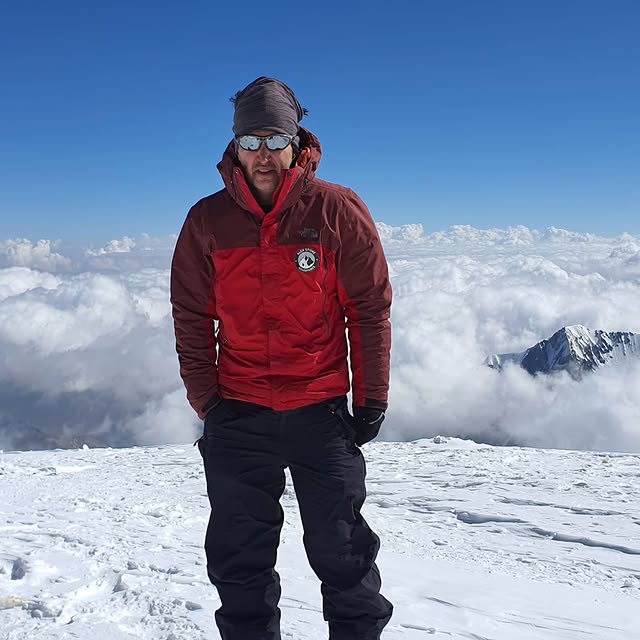
Before the avalanche, Nirmal "Nims" Purja, a climbing sensation, posted on Instagram that the world's twelfth highest mountain would be a late addition to his expedition. He also petitioned the mountain for protection: “Broad Peak, I ask for nothing but safe passage up and back down."
David Klein and Ian Overton did not like what they were seeing. By the last week of July the two men had been living under Pakistan’s 26,414-foot Broad Peak for a month, and the mountain in front of them had dramatically changed its mood. They had come to climb it without bottled oxygen and no porters. Klein, a Hungarian who led the country’s first ascent attempt on Broad Peak in 2000, and Overton, an American ER nurse, tried Nanga Parbat together in winter 2012. This year, they decided to give Broad Peak, the world’s twelfth highest peak, a go.
Most of the teams at base camp had already gone home. On July 25, Klein and Overton packed up and walked out as well. Yet a few teams with summit hopes remained, including that of Nirmal “Nims” Purja, who rose to fame in 2019 after summiting all 14 of the world’s 8,000-meter peaks in record time, and his team from Elite Exped, who were staged at a nearby base camp.
Why they decided to stay is still opaque, but the consequences were deadly. At around 9 a.m. local time on Thursday, July 30, an avalanche swept ten climbers down the mountains’s main west-facing gulley, up to a vertical mile, and a rescue and recovery mission was immediately initiated. The Alpine Club of Pakistan confirmed on Friday that the bodies of two climbers, Nadhira Al-Harthy of Oman and Pur Bahadur Gurung “Yukta” of Nepal, have been recovered; seven climbers have been spotted via drone but it’s unclear if any are still alive. One other climber is unaccounted for.In mid-July, Klein told ExplorersWeb that conditions on the mountain were relatively good and that “avalanche danger is low.” Most of what could slide, he said then, had already slid. On July 19, he followed a Pakistani rope-fixing team up the west side for 19 hours and turned around somewhere between 50 and 70 vertical meters below the summit. Klein was climbing without bottled oxygen. Overton, affected by the altitude, had already returned to base camp.
Klein weighed the idea of making another attempt, but was dissuaded by heavy snowfall that began around July 22. “After lots of snowfall you don’t only want good weather,” says Klein. “You want a few days of good weather in which there is no snowfall, but you are not moving because the snow has to do one of two things. It has to stick to the mountain or it has to slide down.” When the Alpine Club of Pakistan announced the accident late Thursday, it described the group of ten: five Nepalese climbers led by Purja, the Pakistani guide Sohail Sakhi from Moving Mountains, the Omani climber Al-Harthy, American climber Mallory Geis, a Chinese climber identified only as Mr. Wang, and one other foreigner. “The entire team has reportedly been out of communication since the avalanche,” the statement read. Al-Harthy was the first Omani woman to summit Everest. And Yukta had worked for years on the world’s highest peaks. Last fall, he was part of a team that climbed Everest’s north face to support mountaineer Jim Morrison’s first ski descent of the famed Hornbein Couloir.
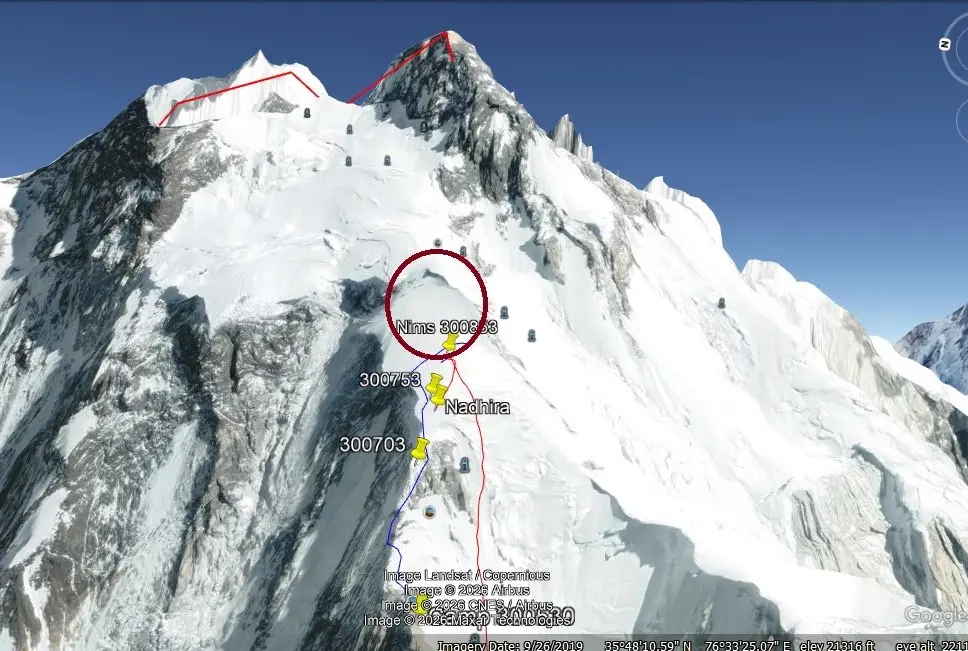
Purja, like most climbers, carried a Garmin device, and it broadcast his position for four hours after he left Camp 2 that morning. The first pings put him at 6,166 meters—20,231 feet, right about at Camp 2—at 5:33 a.m. Pakistan time on Thursday July 30. Al-Harthy’s device broadcast similar readings. From there the track ascended steadily: By 7:03 a.m. the Elite Expedition team had reached 6,430 meters.
Purja and Al-Harthy’s next pings both came just before 9 a.m. local time, at around 6,660 meters—21,850 feet. Then, the pings from his device placed him more than 2,000 feet below his position just 30 minutes earlier. Al-Harthy’s GPS signal also disappeared from the upper slopes of the mountain and hers turned up more than a vertical mile below. None of the climbers appear to have been heard from since.
Elite Exped’s cofounder Mingma Gyabu Sherpa, known in the mountains as Mingma David, holds out hope for Purja, citing that his GPS tracker was still moving after the fall. “Nims location is moving brother,” he said in a text message. “We hope brother he is still live [sic] we need rescue because he is GPS location moving.”
Purja’s tracker has since generated a few more pings that appear to show slight movement, but it registers a speed of zero and the battery reading is now low. Both Purja and Al-Harthy’s trackers showed the same signature: a rapid descent followed by a short final displacement to the north. GPS units under snow or in deep, steep terrain often keep transmitting, but their reported positions become unreliable and a stationary device can appear to wander. It is difficult to overstate what Purja has done to Himalayan climbing, or how fast he did it. Both of us have covered mountaineering for over a decade and there has never been a character quite like Purja.
Share Your Thoughts
0 approved comments
Sign in to join the discussion
Registered customers can leave a comment and rate this article.
Start the conversation
No approved comments yet. Be the first signed-in customer to share a thought.